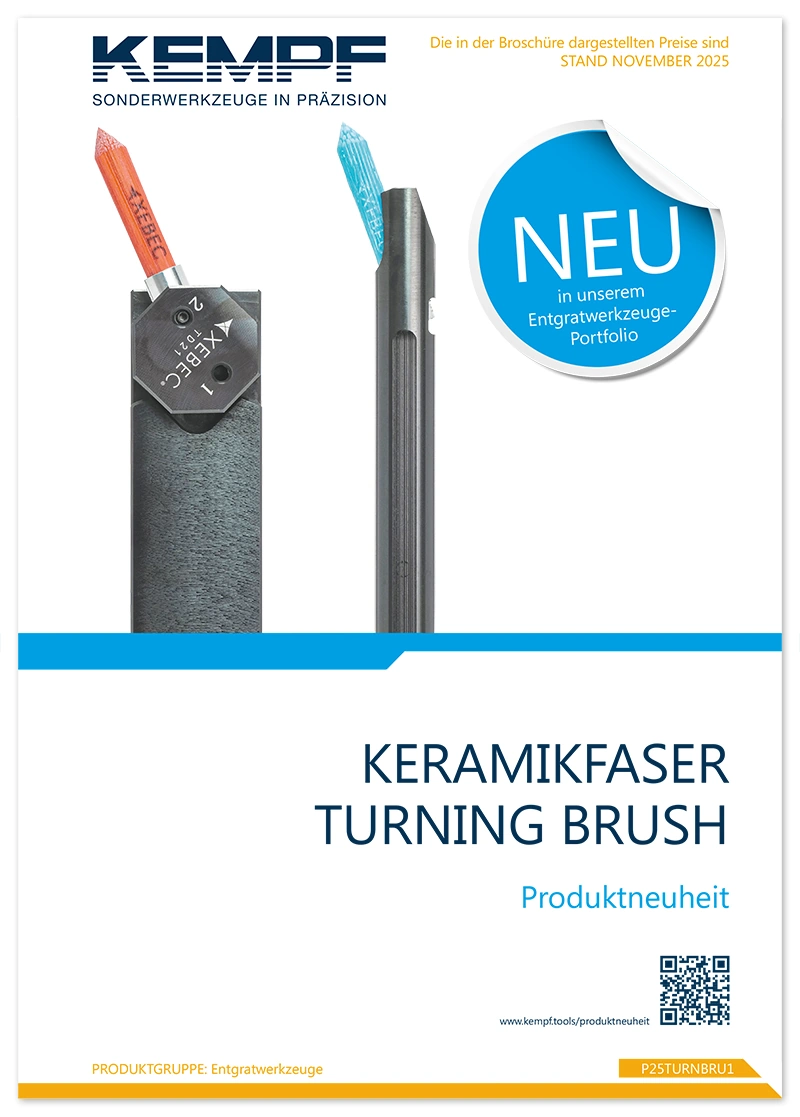
Ceramic Fiber Turning Brush
For deburring cross-holes and grooves as well as external and internal threads on the lathe with stationary tool
Your Advantages
Automated deburring of small burrs directly on the lathe
No manual deburring effort and no tool change required
Consistent deburring quality and high process reliability
Deburring multiple cross-holes in a single operation
Suitable for internal and external geometries
Also suitable for polishing cylindrical, flat, and bore surfaces
Easy integration without complex programming

Video 1: Deburring External Thread & Cross-Hole
The ceramic fiber brush enables automated deburring of small burrs (< 0.1 mm) directly on the lathe. For this purpose, the tool is used as a static tool in the turret, allowing deburring operations to be integrated immediately into the machining process. Additional manual steps or reclamping of the workpieces are eliminated.
Multiple cross-holes can be deburred in a single operation. Furthermore, the tool is suitable not only for deburring but also for polishing cylindrical surfaces, flat surfaces, and bores.
When using square shank tool holders, the brush angle can be individually adjusted. This allows the ceramic fibers to be optimally aligned with the burr edge. Depending on fiber stiffness, angle of attack, feed rate, and spindle speed, the cutting effect can be precisely adapted to the specific application.
Programming is particularly simple, as the tool is usually moved only along the Z-axis from Z− to Z+ in most applications. This enables quick integration into existing machining programs while ensuring high process reliability and reproducible deburring results.

The CERAMIC FIBER TURNING BRUSH is offered in four variants.
Two
types with square shank and adjustable brush angle and two types
with round shank and fixed brush angle.
SQUARE SHANK TOOL HOLDERS WITH ADJUSTABLE BRUSH ANGLE
For the tool holders with square shank, the brush angle
is adjustable to optimize the deburring effect, while the brush angle
of the two round shank tool holders is fixed at a shallow angle. The advantage of shallow angles (closer to horizontal) is that the flexible fibers can deburr irregular surfaces such as cross-holes.
The square shank also allows for steep
brush angles (nearly vertical). This concentrates the abrasive force of the
ceramic fibers on the tip of the brush, making it ideal for deburring threads.
FOR EXTERNAL THREADS: THE STEEPER, THE BETTER
A steep brush angle (below 90°) enables defined
contact between the ceramic fiber and the burr without splitting the brush bundle,
ensuring high abrasive performance. When passing the brush over
the thread, it sweeps over the thread peaks and removes protruding burrs.

Video 2: Deburring with Ceramic Fiber Brushes
The machining direction of the ceramic fiber brush must always be opposite to the brush tip. This pulling motion minimizes bristle deflection and securely engages the edges to be deburred. In a pushing motion, the bristles would splay and break.
 DEBURRING CROSS-HOLES
Flat brush angles and large depths of cut are required to deburr cross-holes. For a more uniform result, deburring can be performed in both clockwise and counterclockwise directions.
 DEBURRING THREADS
A steep brush angle (22.5°) is required for deburring external threads. The correct rotation direction of the workpiece is clockwise M03 for right-hand threads and counterclockwise M04 for left-hand threads.