HSD: Deburring of Intersecting Bores
Fast and process-reliable deburring of intersecting holes, edges, slots, grooves, shoulders, and steps
Your Benefits
Rotating and stationary use possible
Pressure-controlled cutting edges for process-reliable deburring
High feed rates and spindle speeds possible
Suitable for bore overlaps, grooves, steps, and angled bores
Also suitable for cross-holes and deep-hole bores
No impact on the workpiece surface in the main bore
Patented tooling system, recommended for robotic applications

Video 1: Function of the HSD deburring tool
The HSD special deburring tools are typically used for intersecting bores or cross-holes, slots, grooves, shoulders, and steps. They are used for internal deburring as well as external deburring, for example on shafts. The technology is applicable to a wide range of main and cross-hole diameters. The tools can be used through the main hole or through the intersecting holes based on the principle of a back countersink.
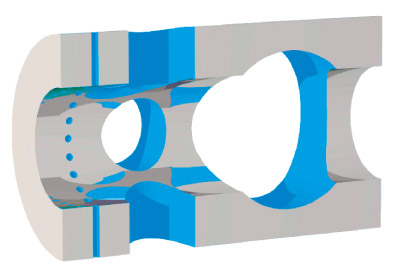 |
Multiple intersecting bores are preferably deburred through the main bore with a single deburring tool in one step. All intersecting bores, including those with different diameters, are deburred in this process. |
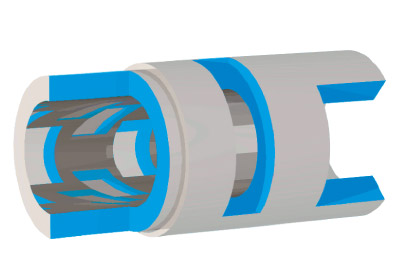 |
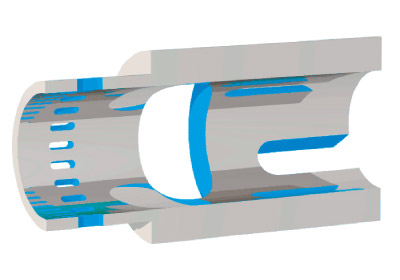
The machining of slots or long holes does not fundamentally differ from cross-holes. Here as well, all openings are deburred in a single operation. |
 |
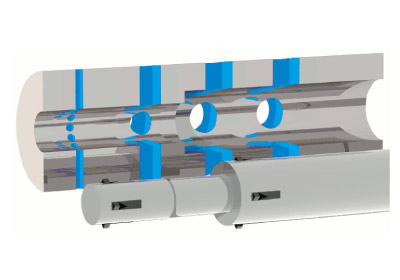
Steps or notches are deburred through the bore. For slotted shaft ends, the use of combined internal and external deburring tools is particularly effective. |
 |
For stepped bores with varying diameters, step tools can be used as custom tools. Special solutions are also developed for other special cases. |
The smallest diameter currently realized for an HSD tool is Ø 2.8 mm. There is theoretically no upper limit for the diameter.
Cross-holes with a minimum diameter from Ø 1.0 mm are deburred through the main bore.
Due to the cutting edge shape and the control of cutting force via the pressure medium (oil, air, coolant), the surface roughness depths in the bores are only marginally altered and affected.
The deburring result and edge formation can be controlled via feed rate, pressure, and spindle speed.
Video 2: Deburring Various Bores
The HSD deburring tool deburrs edges using the pivot-mounted cutting edges. It can be used through the main bore or like a back countersink. In most cases, it is operated in both clockwise and counterclockwise rotation to evenly deburr both sides of the bore.
The force on the cutting edges is applied by pressure from a medium through the shank. No spring elements are used. Suitable media include water, coolant, drilling emulsions, oil, or compressed air, including MMS. Due to the fast response time, coolant-activated cutting edges offer a significantly wider range of applications compared to deburring tools with spring-loaded edges. The cutting force can be adjusted by the pressure.
Without pressure, the cutting edges retract without force. When pressure is applied, the cutting edges are pressed against the bore wall and then spring back at the edge—i.e., at the burr. If no pressure medium is available, an elastomer tool can be used.

|
In spindle clockwise rotation, the pressure-activated tool (activated cutting edges) enters the main bore.
|

|
The tool advances with the working feed to the end of the main bore and deburrs all cross-holes. |

|
Once the bore end is reached, the feed is stopped and the spindle direction is reversed to counterclockwise. The tool retracts with working feed, preventing the usual secondary burr formation. This is the only way to ensure 100% deburring. |
| When the tool enters the main bore, the cutting edge is "retracted" inside the tool shank. | At the desired position, the cutting edges are "deployed" by the pressure medium. The cross-hole is deburred. |

|

|
Read practical application reports on the "HSD deburring tool":
» Achieve burr-free valve housings straight out of the machine with "High Speed Deburring"