Your Guide to #burrfree Machining
What is deburring? In almost all machining processes, unwanted burrs form due to cutting, drilling, or milling: excess material on the machined workpiece. For quality and precision components, burr removal—deburring—is essential. Why deburr? Burrs can impair the function of the machine or end product, for example, through fit inaccuracies or poor thread engagement. Process reliability is compromised. Additionally, burrs pose a risk of injury from cuts. High burr-free standards are also required for quality specifications on finished components, such as in medical or food industry applications. Removing burrs improves the service life and reliability of your products, meets stringent quality requirements, and increases customer satisfaction. How to deburr? Learn why machine deburring is so important in the FAQ section below.
FAQs about Deburring
In order to be able to remove a burr without leaving any residue or to be able to machine a workpiece #burrfree, it is first necessary to define what a burr actually is.
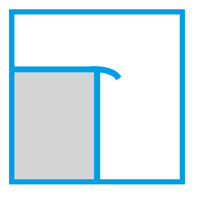
According to German Standard DIN ISO 13715, workpiece edges are considered "burr-like" if their protrusion is a deviation of > 0.05 mm from the ideal geometric shape. Smaller burrs are considered sharp-edged or even #burrfree. In practice, the picture is somewhat different. Which burr heights or burr root thicknesses are still accepted on a workpiece edge depends strongly on the requirements of the component and differs from application to application.
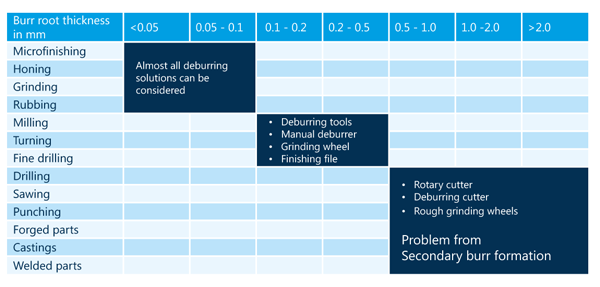
The size of the burrs or the thickness of the burr root is a decisive factor in selecting the optimum deburring solution. In general, the more massive the burr, the fewer deburring solutions there are. Therefore, the focus is on designing the pre-machining in a way to minimize burrs as much as possible. One option is to use specially developed tools such as burr-minimizing drills or special deburring cutters that also avoid secondary burrs. One option is to use specially developed tools such as burr-minimizing drills or special deburring cutters that also avoid secondary burrs.

Deburring is a time-consuming and therefore cost-intensive work step and is therefore an important item in the cost calculation. Depending on the #burrfree requirements of the workpiece edge, a well-designed burr-minimizing machining process can possibly eliminate the need for a deburring tool afterwards. If this is successful, a very economical machining process is achieved without the use of another tool.
But even if the use of a further tool remains necessary, burr-minimal pre-machining is always important, because deburring tools that follow in the machining process can then be used much more effectively and economically. Contact us! We would be happy to look at the entire production process with you and advise you on optimization options for burr-minimizing pre-machining!

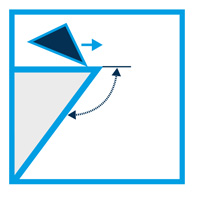
The edge angle plays a major role in burr formation. The sharper the edge, the larger the burr that is generated.
At chamfered edges or countersunk holes, only a minimal burr occurs from a blunt edge angle of < 45° and practically no burr at 30°. Extremely positive, acute edge angles make deburring much more difficult. Pointed edge angles on the workpiece should therefore be avoided wherever possible.
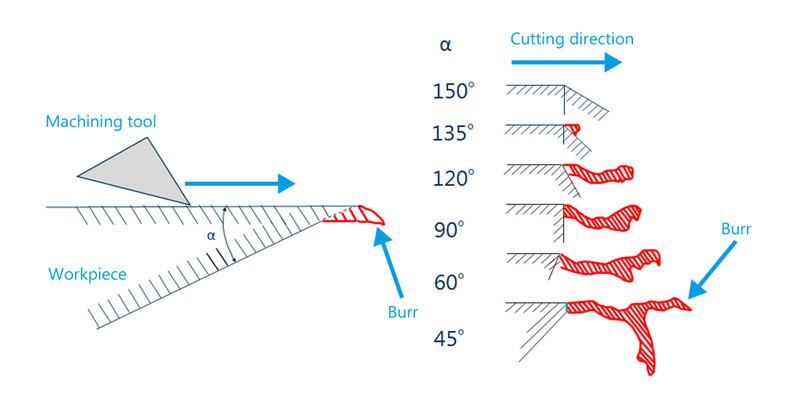
In order to be able to produce a component that is as free of burrs as possible, it is NOT only the actual deburring tools that are important. Rather, it is also important to keep an eye on the actual "preparatory work". Not only chip- and edge angles have an influence on burr formation, the tool itself plays a crucial role.
Optimized cutting tools with sharper cutting edge geometries also generally lead to less burr formation - with shorter tool life. However, in the field of machining non-ferrous metals, for example, it is possible to achieve both the goal of minimi- zing burrs and the goal of maximizing tool life. The use of PCD as a cutting material and an appropriate tool design make sense here.
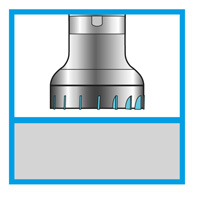
Burr minimization can also often be achieved by adjusting the machining parameters where the tool meets the workpiece edge. For example by:
- Reduction of the depth of cut for a face milling operation
- Reduction of the feed rate at the exit of the bore hole

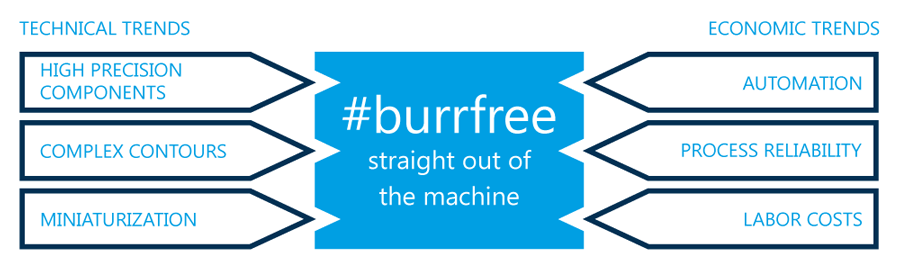
With the ever more complex requirements for high-precision components with increasingly difficult workpiece contours, today's competitive advantage lies in manufacturing these components with a consistent high quality - #burrfree.
If deburring is implemented in the production process of the CNC machine, not only time is saved, but resources are also gained that were previously tied up. CNC deburring with the use of machine deburring tools almost always leads to lower unit costs in series production and at the same time to fewer quality defects or complaints from the end customer.