


The Most Common Deburring Methods
Deburring is a crucial step in the manufacturing industry that improves the quality and safety of products. By removing sharp edges and burrs, injuries are avoided and the functionality of the components is optimized. Below we present the common deburring processes used in various industries to increase efficiency and precision in manufacturing. From traditional manual methods to advanced automated solutions, we provide an overview of the many techniques that can be used for deburring.
Mechanical Deburring
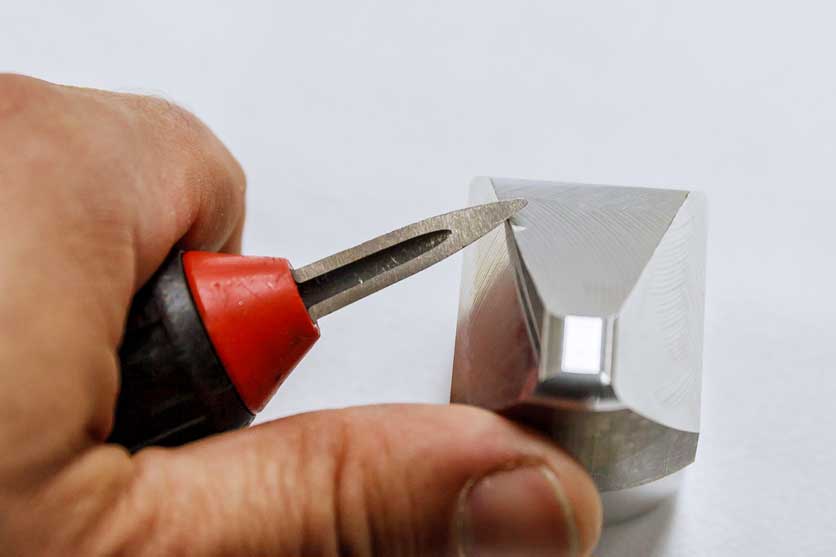
Mechanical deburring means that the burr created on the component during machining is removed by targeted brushing, milling or polishing on the inside or outside of the workpiece. This step is often done by hand for small series or if the situation requires it. For higher quality requirements or larger series, it is recommended to deburr directly on the machine during the machining process. In this case, the component comes out of the machine completely finished. The final processing step of deburring can even be automated or performed by robotics. Deburring directly on the machine offers a decisive competitive advantage, as it reduces process costs and throughput times.
Manual deburring is widely used for small series or where the situation requires it. This may sound simple, but it should not be underestimated.
High-quality, consistent manual deburring requires a high level of concentration and a great deal of manual skill in the presence of noise and dirt. Manual deburring is often carried out by the machine operator in conjunction with machining directly next to the machine. Manual deburring is usually only carried out on individual parts or on a situational basis.
There are several suppliers in the market who offer special manual deburrers with a wide variety of blade shapes. KEMPF, for example, supplies the Shaviv Hand Deburrer.
Air-powered or electric tools with mounted points, deburring cutters or brushes are also often used. Here we recommend the XEBEC Ceramic Fiber Surface Brushes made of self-sharpening ceramic fiber, our Carbide Rotary Cutters or our Ceramic Fiber Mounted Points.
Manual deburring also includes roughing and finishing files, grinding wheels, sandpaper and other similar tools.
For manual use, selected deburring tools that are intended for machine processing can also be used manually. Semi-automatic deburring tools with spring-loaded cutting edges, such as our Burraway, our Burr-Off Deburring Tool or the E-Z-Burr, are ideal for this purpose.
- Cost-effective deburring tools, especially for small batches
- Deburring of sensitive components and critical contours is possible
- Direct control by the user
- No consistent deburring results, often dependent on “daily form”
- Sometimes high demands on the skill of the employees
- Risk of damage to the workpiece
- High effort required for follow-up checks
- Relatively time-consuming and high personnel costs
Machine Deburring
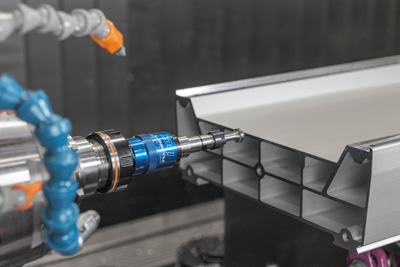
With machine deburring, the workpiece is finished directly in the machining center. The component comes out of the machine finished and in consistent quality - an additional process step for deburring is no longer necessary. Deburring can also be integrated automatically into the machining process. Here, the required deburring tools are stored in the CNC machine's tool magazine and automatically changed via the tool changer. In general, machine deburring offers the great advantage of consistent, reproducible results. Even with today's requirements for high-precision components with increasingly difficult workpiece contours, components are produced in consistently high quality without burrs (#burrfree). Resources that were previously tied up can be used elsewhere. The competitive advantage is obvious: process and throughput times are reduced and quality defects are minimized.
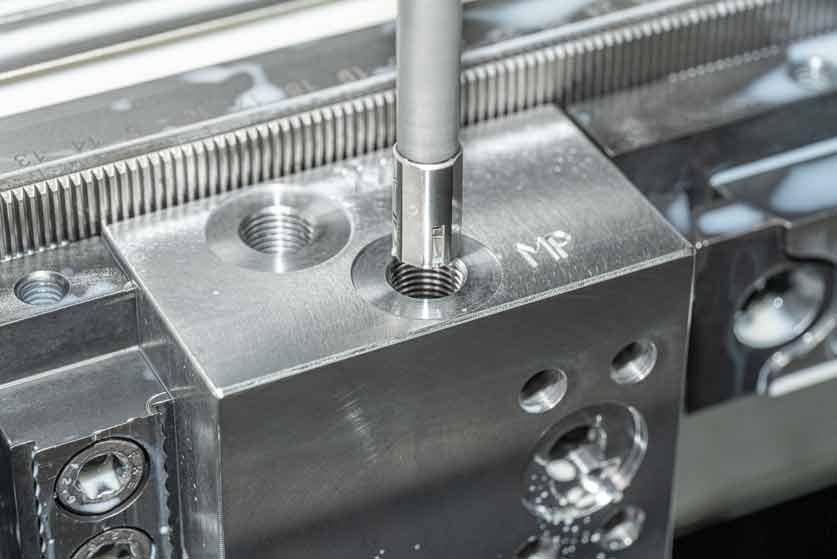
This is a machining process generally used to deburr the back of holes, often with the option of deburring the front.
The cutting edges are under pressure (spring pressure, preload for fork tools or coolant). The pressure is usually adjustable or can be adapted to the deburring process or the material.
These tools are used in the same way as drilling tools; they are guided centrally through the hole to be deburred in clockwise rotation. The cutting edge folds in automatically during the feed. Defined deburring with spring-loaded cutting edges is only possible to a limited extent and with restrictions.
We recommend the following tools
- our Burraway, Burr-Off or E-Z-Burr for front and rear deburring and chamfering of bores,
- the GMO Deburring Tool for deburring and chamfering the rear side of boreholes or
- the HSD for deburring intersecting bores.
- Automated deburring
- Components get out of the machine ready-deburred
- Good reproducibility of results, therefore high process reliability
- Cost-effective standard deburring tools
- Low-priced replacement cutting edges available in HSS or carbide
- Defined deburring with spring-loaded cutting edges is only possible to a limited extent and with restrictions
- In the case of overlaps, the application range is limited depending on the bore ratio
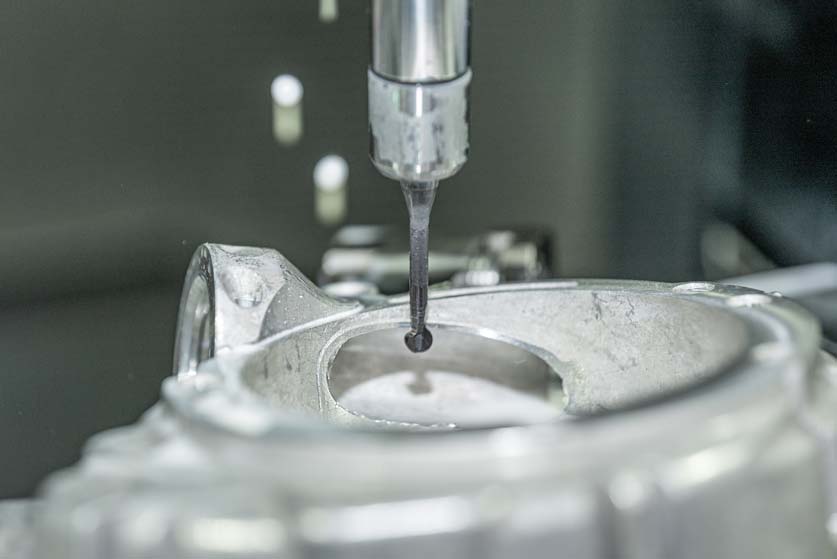
Circular deburring cutters perform precise and even deburring, even in hard-to-reach areas. Their special cutting geometry enables efficient material removal, even with 3D shapes. In conjunction with 3-axis machines and appropriate programming, there are virtually no limits to the range of applications for these tools. The only limitation is the operating length.
The use of deburring cutters requires defined contours in relatively narrow workpiece tolerances. To extend the range of application to undefined edges (e.g. cast, forged or welded parts), it is possible to use an axial compensation holder. Axial compensation in tension and compression, along with specially developed 45° deburring cutters, also enables machining of undefined edges and contours. Thanks to its compensating holder, the cutter is pushed away from dimensional deviations on the workpiece when it moves off and therefore deburrs evenly all round with the same force.
We recommend the following tools
- the Back-Burr Cutter & Path Deburring System for front and back deburring of edges on 3D curved surfaces . It was specially developed for deburring and enables secondary burr-free processing. Due to the often very complex CNC programming, we offer optional NC data sets for optimum deburring results and maximum tool life.
- the IBEX Deburring System with axial compensation holder for deburring even undefined contours
- our Carbide Rotary Cutters and Burrs
- Automated deburring
- Components leave the machine ready-deburred
- Good reproducibility of results, resulting in high process reliability
- Very good deburring results for defined edges
- With axial compensation holder, even suitable for undefined edges; can therefore also be used on 2-axis machines
- Long tool life
- Optional NC data sets for CNC programming available
- Without axial compensation holder, 3-axis CNC machines are required
- High programming effort (except with compensation holder)
- Not suitable for undefined edges, such as casting contours or similar (except with compensation holder)
- Working length limits the range of application
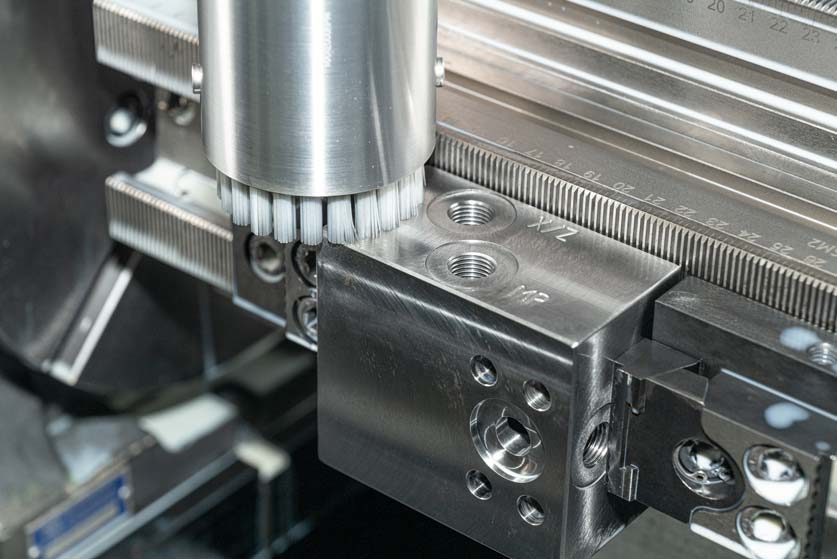
Deburring with brushes is also widely used on CNC machines. The deburring contour does not have to be followed in a defined manner, which saves time. However, it can be difficult to achieve a uniform deburring result if the burr formation varies. It should also be noted that the abrasion from abrasive deburring brushes is flushed along with the coolant and can lead to soiling of the machine.
There are numerous suppliers on the market with a wide variety of brush types, from steel, brass or nylon brushes with different fillings (AlO, SiC, diamond, etc.) and with grit sizes from 36 to 8000 to ceramic fiber brushes or honing brushes.
We have specialized in ceramic fibre brushes, whose 1000 bonded bristles are not only coated with ceramic, but also consist of 80% abrasive ceramic throughout. They offer the great advantage that the self-sharpening cutting edges enable a constant abrasive performance.
In contrast to wire brushes, the ceramic fiber bristles return to their original shape after processing. These brushes can be used in a wide range of applications, especially in conjunction with an axial compensating holder, and impress with their long service life, higher productivity and lower costs.
We recommend these ceramic fiber brushes:
- the XEBEC surface brush for deburring and polishing surfaces,
- the XEBEC Cross-Hole Brush for deburring cross holes and polishing or descaling hole walls,
- the XEBEC Wheel Type round brush for lateral deburring and polishing of surfaces, edges and threads.
- Quick and easy to use
- Different brush types with a wide range of applications
- Also suitable for undefined edges
- Surface improvement possible (grinding / polishing of surfaces)
- Long service life possible in some cases
- Can be used flexibly with axial compensation holder
- Usually rather low material removal rate
- Wear and cutting performance difficult to calculate
- No defined deburring
- Possible soiling due to abrasion and particles
Robotic Deburring
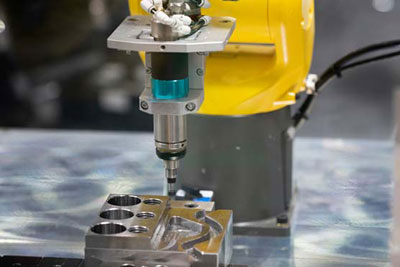
Deburring with robots is carried out with deburring tools that are also used for mechanical deburring. These are primarily tools for grinding, brushing, milling or countersinking. The challenge in robot processing is the interaction between the tool, fixture and robot. The further the robot arm extends, the more unstable the machining becomes. Sufficient rigidity must therefore be ensured. There are two fundamentally different strategies for setting up the robot system:
Here, the workpieces to be deburred are picked up by the robot using a gripper and guided along the permanently attached deburring unit under program control.
This procedure is preferred above all for small and medium-sized components and is usually used in series production.
Here, the flexible robot arm processes a firmly clamped workpiece and moves along the workpiece edges in a defined manner.
The tool-guided strategy is particularly preferred for larger components with complex contours, as it is much easier to move the tool than the large, bulky component. Another advantage here is that the robot can pick up several tools via a changing station and can carry out a wide variety of deburring operations on the component using an automatic tool change.
- Can be used universally with a wide variety of deburring tools
- Processing of even complex contours possible
- External deburring process shortens machine run times for part processing
- Efficient process for the production of large series
- High investment costs for robot and deburring unit
- External, separate robot station required
- Usually only profitable in series production
- Time-consuming programming for complex components
Alternative deburring processes
Our range of high-quality deburring solutions for almost every application covers the broad field of mechanical deburring, as just presented. Nevertheless, we would like to give you an overview of numerous alternative deburring processes in which deburring is carried out separately from part production in a separate process.
This deburring process in accordance with DIN 8590 uses direct current electrolysis to enable targeted material removal.
The workpiece forms the anode (positive pole) and the tool the cathode (negative pole). The tool is positioned a short distance from the edge of the workpiece. An electrolyte solution then creates the electrical connection, causing the burrs to dissolve.
This deburring process is particularly interesting for the targeted rounding of edges and bore transitions.
- Fast deburring process for high quantities
- Deburring possible in hard-to-reach areas
- Hard machining possible
- Secondary burr-free machining
- Generally produces good workpiece surfaces
- External, separate ECD machine required - High investment costs
- Pick-up device and tool/cathode must be specially adapted to the respective machining process
- Risk of short circuit if burr is too massive
- Burr height max. 0.3 mm permitted
- No contamination by oil, emulsion or similar permitted
- Only profitable in series production or as contract work
The thermal-chemical deburring process is also known as “explosion deburring”. In this process, high temperatures of up to 3000°C are generated in a combustion chamber by igniting a mixture of oxygen and gas, which act on the workpiece for a few milliseconds. These high temperatures cause the fine protruding burrs to vaporize, while the workpiece itself is only heated moderately to up to 160°C.
If a workpiece has internal burrs that are difficult to access, this process is well suited.
- No material removal on the workpiece surface, minimal edge rounding
- Suitable for oxidizing materials and plastics
- Also suitable for bulk material
- Deburring strength can be controlled by the gas mixture
- Can be used variably for various contours and components
- Suitable for deep-hole drilling
- Well suited for poorly accessible, internal bore overlaps and complex contours
- Short processing times
- External, separate TEM machine required - High investment costs
- No defined edge rounding possible
- Only partially suitable for hardened parts
- Burr thickness max. 0.2 mm
- Critical for thin-walled parts (strong heating)
- Burning residues (reworking) and visual impairment of the surface possible
- Limitation of part size and quantities due to the size of the combustion chamber

In water jet or high-pressure deburring, a water jet with a pressure of up to approx. 1000 bar is used for deburring. The pressure is directed via nozzles onto the areas to be processed. This removes the protruding burrs. This process is particularly suitable for workpieces with hard-to-reach areas or for cleaning. Deburring and cleaning can be carried out directly in one operation.
- Suitable for complex contours, deep-hole drilling, internal hole overlaps, etc.
- Suitable for a wide range of materials (e.g. metals or plastics)
- Low edge rounding (sharp-edged, burr-free)
- Deburring and cleaning in a single operation
- External, separate HD machine required - High investment costs
- No defined edge rounding possible
- Only suitable to a limited extent for solid burrs (burr root may remain)
- Only suitable to a limited extent for tough materials
In this process, a medium (fluid) mixed with abrasives is forced through the inside of the workpiece and back again under pressure via a hydraulic component. This process is usually repeated several times, depending on the burr thickness and the desired edge rounding. A wide variety of grinding particles (ceramic, diamond, aluminum oxide, ...) in different particle sizes are used to adapt to a wide range of materials, burr thicknesses and surface requirements.
- Suitable for even the smallest bore diameters from 0.1 mm
- Deburring possible in hard-to-reach areas
- Surface improvement and smoothing possible
- Defined edge removal possible
- Suitable for a wide range of materials
- External, separate HEG machine required - High investment costs
- Limited component size, depending on the chamber size
- Specially adapted mounting form / loading module required for each workpiece
- Complex component cleaning and recycling of the fluid for reuse
- The fluid takes the path of least resistance, i.e. if the bore diameters vary greatly, small bores are deburred less effectively
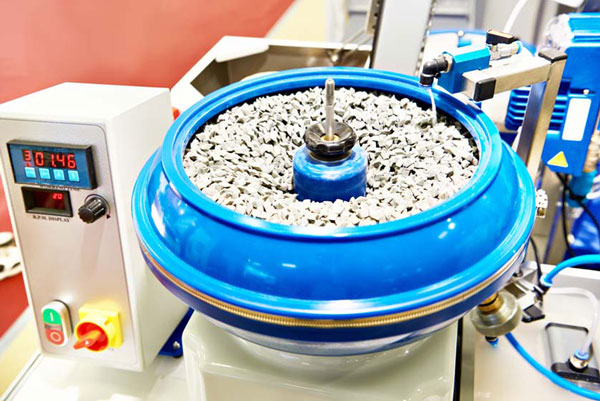
The process was named after the manufacturer Walther Trowal and is defined as “vibratory finishing” in accordance with DIN 8589.
In vibratory finishing, the components are processed in a rotating, vibrating or oscillating drum. Abrasive media (chips) of various sizes and shapes are used and an additive in an aqueous solution is usually added. The edges of the workpiece are rounded or deburred by the movement of the container due to the abrasive particles.
The process is used for fine deburring as well as for surface improvement and for cleaning components. The entire component, inside and out, is processed. No defined deburring can be carried out, but all workpiece surfaces that come into contact with the abrasive media are ground down and rounded. The removal rate and thus the deburring thickness can be varied by selecting different abrasive media and additives as well as the running time of the system.
- Universally applicable for a wide range of designs and geometries
- Suitable for external and internal machining
- Drums available in a wide range of sizes
- Good customization options thanks to different grinding wheels
- Abrasive media are supported by a chemical solution (compound)
- Suitable for a wide range of materials
- Suitable for fine deburring, polishing, improving the surface, grinding workpiece edges, matting, cleaning, derusting and descaling
- Also suitable for bulk material
- External, separate vibratory finishing machine required
- The size of the drum may limit the area of application
- Material is not removed in a targeted manner, but from the entire component; this can be an advantage, but also a disadvantage
- The grinding wheels tend to jam during internal processing
- Massive burrs cannot be removed (burr height < 0.1 mm)
This deburring method is a non-contact process. The components to be deburred are guided in a process water basin at a defined angle along the tip of an ultrasonic sonotrode. It produces ultrasonic vibrations with a frequency of 20,000 Hz. This creates sound waves and a zone of intense cavitation. The implosion of the cavitation bubbles creates pressure peaks that remove the burrs with sharp edges - either selectively or over a large area. The burr can be processed specifically, while the rest of the surface remains undisturbed.
Ultrasonic deburring is suitable for all common metals, including titanium and nickel alloys, brass and fiber-reinforced plastics. The system is programmed in a similar way to the CAM programming of milling centers, followed by a classic post-processor run.
Ultrasonic devices are available from manual modules to complete ultrasonic deburring systems with robot operation.
- Non-contact processing, even for sensitive surfaces
- Suitable for thin-walled and micro workpieces
- Processing of metals and plastics possible
- Holes from Ø 0.1 mm can be deburred
- Internal and external machining possible
- Sharp-edged, burr-free deburring
- Energy-efficient process, low power consumption
- High investment costs for an external ultrasonic deburring system
- Size of components limited by the liquid tank
- Only suitable for fine deburring, no larger burrs
- Not suitable for all materials
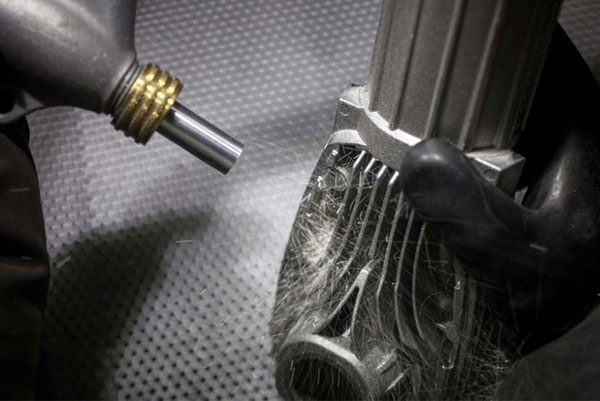
The blasting technique is often colloquially referred to as “sandblasting” or “shot blasting”. Abrasive blasting particles (e.g. sand, steel balls, glass beads or dry ice) are usually accelerated to high speeds using compressed air.
Blasting is used in component cleaning, for derusting and descaling as well as for fine deburring, but also for surface finishing. Deburring is usually carried out under increased pressure and using a wet blasting process. Liquids are added to the blasting agent. Blasting is carried out both manually with blasting nozzles and in complete blasting systems with parts transport through to fully automated line production.
Depending on the requirements, the appropriate blasting process is defined. Factors to be taken into account include the type of surface, the type of contamination, the size of the surface and the cost of the respective process.
- Large-area processing possible
- Even hard-to-reach places can be reached
- Adaptation to the respective task using a wide variety of granules (ceramic, corundum, glass, steel, ...) in a wide variety of shapes and sizes
- Suitable for series production and large components
- The beam area cannot be defined exactly; edge areas are also irradiated in a weaker form or have to be covered
- An exactly defined removal is not possible
- Deterioration in quality due to wear of the jet nozzles
- Verschlechterung der Qualität durch Verschleiß der Strahldüsen
- High investment costs for blasting systems
- Occupational safety and extraction and filter systems are required
A special form of blasting is CO² snow blasting. The blasting medium here is liquid carbon dioxide, which turns into solid snow or ice crystals when it emerges from the nozzle. Areas of application include fine deburring and component cleaning, even on sensitive surfaces such as in the optical industry and medical technology.
Another special form is dry ice blasting. The principle is similar to conventional blasting technology, but dry ice particles are used instead of granules.